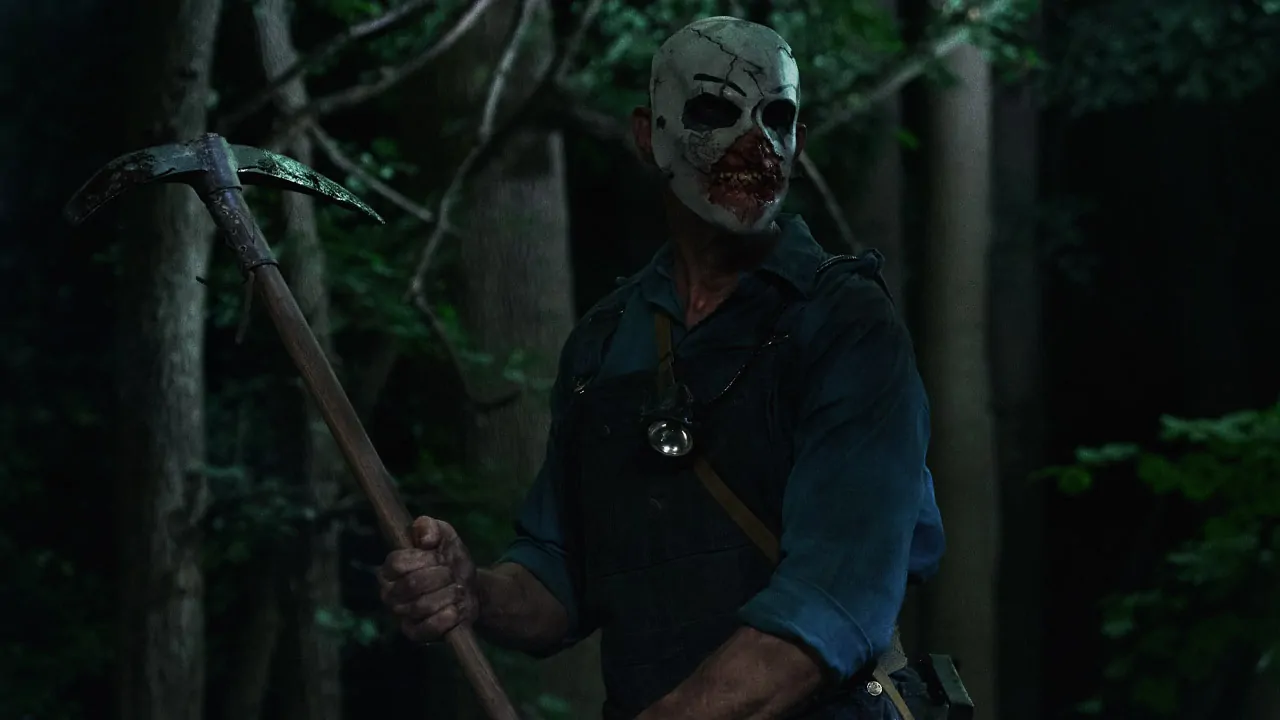
There are two names conspicuously missing from the credits of Until Dawn: Larry Fessenden and Graham Reznick, who wrote the PlayStation hit the film is based on. By the time those end titles roll, though, you’ll understand why: This adaptation has little to do with the game. Those familiar with Fessenden’s filmography will also get this idea from the way the movie retcons/bollixes up (choose one) the origins of Fessenden’s favorite creature, the Wendigo.
Until Dawn is one more production illustrating the pitfalls of bringing a popular video game to the screen. A strenuously faithful translation will just seem redundant (see: Resident Evil: Welcome to Raccoon City), but varying too much from the source risks alienating the target audience. The solution employed by the Until Dawn team has been to tell a new story with the same atmosphere, though “new” here doesn’t translate to entirely fresh. The basic premise is a mashup of Happy Death Day and The Cabin in the Woods; one character even says of their situation, “There’s been a bunch of movies about that,” a line likely to be quoted in many of the reviews.
They have gotten the mood and look right, and engaged the services of some talented genre specialists behind the scenes, including Alexandre Aja’s regular DP Maxime Alexandre and Jennifer Spence, production designer of the Paranormal Activity, Insidious and Conjuring universes. One of the latter was Annabelle: Creation, the superior sequel whose director (David F. Sandberg, also of Lights Out) and writer (Annabelle regular and IT scribe Gary Dauberman) encore on Until Dawn as well. The result feels like a picture a lot of pros worked on, but largely missing the spark of inspiration that would make it a memorably scary experience.
After a prologue that briefly calls back to The Descent, the setup in Dauberman and Blair Butler’s script is basic five-kids-in-a-van, or an SUV. Young heroine Clover (Ella Rubin) wants to get to the bottom of her sister Melanie’s year-ago disappearance, and has brought along Max (Michael Cimino), Nina (Odessa A’zion), Megan (Ji-young Yoo), and Abe (Belmont Cameli) to retrace Melanie’s final steps.
A creepy guy in a rural general store guides them to Glore Valley, where they wind up in a Welcome Center that sports, among other things, a large mounted hourglass and enough posted MISSING flyers to inspire an entire season of Unsolved Mysteries. It also comes with a freakily masked maniac who terrorizes them and kills them all dead—but not for long. That hourglass resets and so does the night, and the quintet find themselves alive again, facing a communal fate of repeatedly dying and reviving unless they can figure out a way to survive until you-know-what.
The horrific agents of their demises vary each time their night restarts, with the idea being that they’ll face a different genre trope every time they come back. There’s no Cabin in the Woods-style deconstruction-and-reassembly going on here, though, just a series of familiar situations and details (a chair that rocks by itself, for example, and then has a spooky clown doll seated on it).
The exception is one passage in which they sequentially meet an especially startling fate; it has a jolting, rude, black-comic charge missing elsewhere in Until Dawn, which sometimes depends on an especially loud Benjamin Wallfisch score to goose the audience. And this scenario in general is a bit counterproductive, since we know it requires that our heroes all die, and then all come back, over and over, which works against the survival-horror suspense. The movie does at least deliver on the splatter score; despite being a youth-appeal project, it’s a hardgore R, with unflinching bodily and cranial destruction and practically created creatures—good work by Applied Arts FX Studio.
While the actors are all personable, with A’zion from the Hellraiser remake bringing an appealing down-to-Earth quality to Nina, the characters aren’t terribly dimensional and their dialogue is largely functional, as they repeatedly ask each other what’s going on and squabble about how to deal with it. Eventually, they discover a handy box full of exposition, which (SPOILER ALERT) leads to a bunch of backstory about yet another decrepit old sanitarium where yet more evil experiments were performed by a weirdo doctor named Alan Hill.
He’s played by Peter Stormare, who would be predictable casting even if he hadn’t previously portrayed this role in the game. There are a couple of other, smaller shoutouts to the PlayStation version in Until Dawn, including one that establishes where the movie fits into the game timeline, though they’re not likely to satiate diehard devotees of the original incarnation.