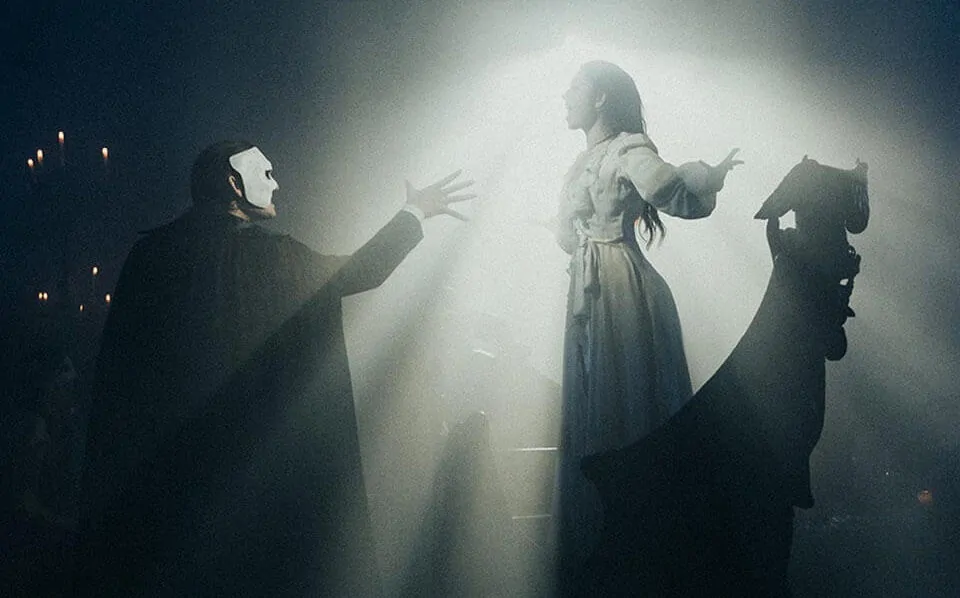
Only the lightest of spoilers below, my angels of music.
Andrew Lloyd Webber’s 1986 musical The Phantom of the Opera, a sumptuous retelling of Gaston Leroux’s 1910 Gothic horror novel, closed in 2023 as the longest-running show in Broadway history. It tells the story of Paris Opera ingénue Christine Daaé, grieving her late father and struggling as a chorus girl when a mysterious figure dwelling within the opera’s catacombs takes her under his musical tutelage. Raoul, a childhood friend of Christine’s who is now Vicomte de Chagny, arrives to patronize the opera and falls right back in love with Christine. Meanwhile, the Phantom wreaks havoc and sacrifices any obstacle to get Christine the starring role he believes she deserves, as opera house officials try to survive while putting on at least one uneventful production.
It’s my favorite musical of all time, based on one of my favorite stories. The songs are flawless; the spectacle is unbeatable. I’ve seen many traveling productions (I even saw Webber’s regrettable sequel Love Never Dies), and I grieved when it closed on Broadway and the West End, before I had a chance to see it in New York or in London, where it originated.
That wrong was righted in its own twisty way this week, after I attended Diane Paulus’ Off-Broadway immersive production Masquerade. Four stories of a building at 218 W. 57th Street have been transformed into the Paris Opera House, and visitors are guided by the Opera’s ballet mistress Madame Giry and her cohorts through the main stage, backstage, ballroom, rooftop, courtyard, cemetery and, of course, underground lair that make up the original setting.

Essentially all of the songs are represented here, more or less every major scene and moment from Webber’s production. But rather than sitting in an audience beneath the chandelier, we’re part of the story. We’re incorporated into key moments, guided so seamlessly that it feels like we’re characters being operated in a video game by unseen players. Or, perhaps more to the point, that we’re being manipulated by a shadowy Svengali off-stage.
I would rather be strangled by the Phantom’s magical lasso than spoil the experience for readers, so I’ll only speak in generalities from here on out. I attended a matinee of Masquerade by myself, which was an especially freeing way to participate. I was masked and knew no one there, and I felt less shy or inhibited than I might otherwise have been. I think because of my apparent openness, I was drawn into the performance by cast members with more intensity than some other attendees. I danced with a chorus girl; I played and won carnival games; I was tricked into poisoning someone.
I lightly wept throughout. I felt this immediate sense of overwhelm, the understanding that I was actually living a dream I’d had since I was a ten-year-old girl belting along to “Think of Me” in my bedroom – I was inside the world of Phantom of the Opera. I was moving through the Paris Opera House with Madame Giry, with Christine and Meg and Carlotta and Raoul. With the Phantom, whose soaring voice and broken heart brought me to tears again and again.
The costumes, the props and the set design were as dark and opulent as in my dreams or in the half-dozen stage productions I’ve seen and loved. As a former stage manager who has utmost respect for that hallowed vocation, I am in awe of the clockwork efficiency yet fluid grace of each transition, the meticulous timing employed to move sixty attendees through rotating scenes, sets and casts every fifteen minutes.
But I’m most enamored of the performances. My main cast consisted of Jeff Kready as the Phantom, Anna Zavelson as Christine, Paul Adam Schaefer as Raoul and Betsy Morgan as Madame Giry. They were all as dreamy as I could have hoped, voices as angelic, every note of grief or yearning or triumph or avarice wholly convincing. My favorite line from Phantom – the most devastating lyric, the one that makes me tear up even as I type it now, and that symbolizes what I love best about this story – is when the Phantom sings, “This face, which earned a mother’s fear and loathing. A mask, my first unfeeling scrap of clothing.” Before he became the Opera Ghost, the Phantom, the Red Death, Erik was a brilliant, musical boy who only wanted to be loved. A lifetime of rejection, hatred, abuse, fear and loathing has warped and twisted him, but he still only wants two things: to create beautiful music, and to be loved.
Masquerade gets at that heart of Phantom of the Opera as insightfully as any traditional production ever could – maybe more so. There’s one new scene, written by Webber and nodding to Leroux’s original text, that adds more nuance to the Phantom’s tragedy, and it fits in perfectly with this multidimensional experience. It works both emotionally and theatrically.
If you’re a fan of Phantom of the Opera, or of immersive theater experiences like Sleep No More (a comparable production, though Masquerade is less open-world than Sleep), and if you have the means to make it happen, Masquerade is a miracle well worth your time and travel. Get your tickets here, but if you go, go with an open heart. Leave your phone and inhibitions at the door, allow all your senses to abandon their defenses, and give yourself the gift of forgetting time, reality and yourself for two hours. That’s all I ask of you.